
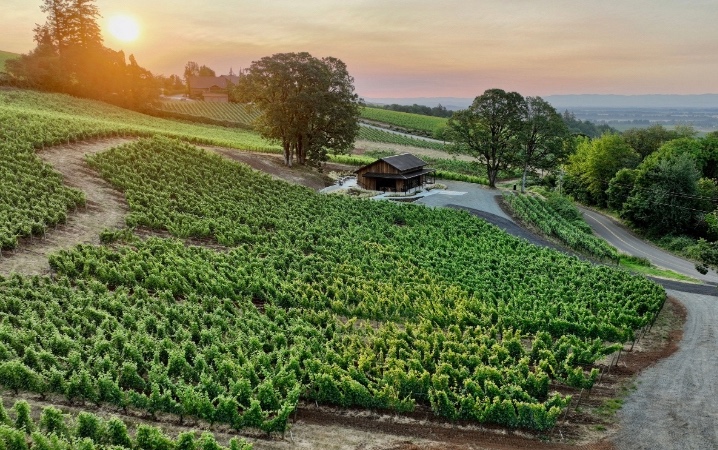
Terroir is alive and well in Oregon. You just need to know where to look, and Résonance Wines provides a very strong option for discovering it.
After first dipping their Burgundy-stained toes in the water just over a decade ago when they launched Résonance, Maison Louis Jadot, one of Burgundy’s venerable producers, has dived deeply into Oregon. It was a perfect storm for Jadot in 2013 when they acquired the Resonance Vineyard. Jacques Lardière, Jadot’s legendary winemaker had just retired after completing 42 vintages with them … and was ready for a new challenge. Thibault Gagey, son of Pierre-Henry Gagey, Jadot’s longtime CEO, was ready to take on more responsibility within the company. So, presto, a new trusted and seasoned team would be ready to go as soon as they found the right site.
When Pierre-Henry, Thibault, and Jacques saw the property for the first time, they immediately fell in love with it: A dry-farmed 20-acre vineyard containing 40-year-old Pinot Noir vines planted on their own roots. Unheard of in that era, the vines had always been tended organically. If that wasn’t enough, the plot sat atop very old soil – geologically speaking – that was ideally suited for vines. Jacques, in his uniquely quasi-spiritual way, felt there was “magic” lodged in the place. They kept the site’s name, just adding a French language accent. Initially, not wanting to invest too heavily in a project that might not succeed, they rented space in a neighboring winery instead of building their own production facility.
Success came quickly. Today, Jadot has its own state-of-the art winery and tasting room as well as 100-acres of Pinot Noir and 40-acres of Chardonnay vines spread over three AVAs, Yamhill-Carlton, Dundee Hills, and Eola-Amity. With wines sourced from these different AVAs, they show the importance of terroir, just as in Burgundy.
That different locales in Oregon produce significantly different wines even when using the same variety of grape and winemaking technique should, in one sense, surprise no one. The French have no monopoly on terroir. Its influence and importance are apparent around the world, from Barolo, to Napa, to Chile’s Central Valley and Australia’s Barossa – to cite just a few examples.
In another sense, however, it can be difficult to persuade more consumers about the significance of “place” in finished wines because, to do so, it is necessary to distinguish between wine characteristics rooted in growing sites from other wine attributes stemming from the producer’s influence. Stated more concisely, some have described this as the challenge of distinguishing between the importance in wine of the “land versus the hand.”
If, for example, I taste a Domaine Drouhin Oregon Pinot Noir from the Dundee Hills side-by-side with a Résonance Pinot Noir from the Yamhill-Carlton AVA, is the difference due to the site – the terroir – or to the growing practices and winemaking style of Drouhin versus Jadot?
Well, now, with vineyards in multiple AVAs and the winemaking philosophy of Résonance’s wines held “constant” as a variable under the watchful eye of Guillaume Large, who took from Jacques in 2017, the consumer can see the dramatic difference between Pinot Noir grown in these two sites.
To be fair, Jadot was the not the first to show the importance of terroir in Oregon. The Drouhin family with their Domaine Drouhin Oregon has been doing the same thing over the 30+ years they’ve established a presence in Oregon. But Jadot, along with other Oregon producers who make wines from different AVAs, like Nicolas-Jay, Ken Wright Cellars, and Lemelson Vineyards, to name just three, are adding to the ease with which consumers can discover the importance (and seeming magic) of terroir for themselves.
Although Jadot’s Oregon venture, Résonance, started with Pinot Noir, Large exclaims, “The terroir of Willamette is also connected with Chardonnay.” He continues, “The volcanic and sedimentary soils provide stylistic diversity, just like with Pinot Noir.” Importantly, he adds, you need acidity, which these soils provide, to balance the expression of Chardonnay that comes with ripeness. Like the initial Résonance Vineyard, all their newly acquired vineyards are dry-farmed and organic, which Large believes brings more abundant acidity to the grapes and the resulting wines.
Large explained to me when I visited in 2023 that organic and un-irrigated viticulture allows you to “see” the terroir of the site more quickly, which is why they’ve stuck with their meticulous approach without irrigation or the use of chemicals.
After buying Résonance in Yamhill-Charlton AVA in 2013, Jadot added Découverte Vineyard in the Dundee Hills a year later. They also expanded their footprint in Yamhill-Carlton by purchasing additional vineyards adjacent to Résonance, which they call Joli Mont (literally “pretty hills”) that they planted with more Pinot Noir and some Chardonnay.
In 2022, Jadot expanded again, purchasing Koosah Vineyard in Eola-Amity Hills, ironically from Kevin Chambers, from whom they purchased the Résonance Vineyard a decade earlier. After Chambers sold Résonance to Jadot, he and his son purchased and developed Koosah Vineyard. (Large explained that Chambers was a great farmer but did not want to make wine.) When his son decided not to take over Koosah and make wine, Chambers sold it to Jadot! Koosah, with its volcanic soil, is planted with 26-acres of Chardonnay and 18-acres of Pinot Noir, roughly half of each being “own-rooted” (or un-grafted onto pest-resistant rootstocks). Large is worried about the vineyard’s potential to be infected with phylloxera, but he hopes its isolation, like that of Résonance, will keep it uninfected.
With black cherry-like fruitiness, the muscular 2022 Pinot Noir from the Résonance Vineyard in Yamhill-Charlton (94 points, $75) contrasts nicely with the lighter, red cherry-like fruitiness and elegance of the 2022 Pinot Noir from the Dundee Hills’ Découverte Vineyard (93 pts., $75). The 2022 Pinot Noir from Koosah vineyard in Eola-Amity Hills AVA also displays a red rather than black cherry-like fruitiness but adds an alluring mineral component (94 pts. $75). You can almost taste the lava!
In my experience, these three wines accurately reflect the general character of Pinot Noir from their respective AVAs and clearly show that the sites etch their stylistic signature onto the wines. All three of these delectable Pinot Noirs are balanced and fresh, and delicious to drink now – a testament to Large’s viticultural and winemaking practices. You might select the Découverte Vineyard Pinot Noir for a simple roast chicken, or the Koosah if you added a mushroom sauce to the chicken. The Résonance Vineyard bottling would be a good choice when beef is on the menu. I don’t like to split hairs regarding food and wine pairing, so frankly, I’d be happy drinking any of these three with grilled salmon.
The terroir obviously has an enormous impact on these Pinot Noirs, but comparing the 2014 and 2017 Résonance Vineyard Pinot Noir from my cellar showed the enormous influence of Large’s talent – he made the 2017 – and the age of the vines: The ‘17 was more refined and had better texture.
Resonance’s Chardonnays are equally adept as their Pinot Noir at reflecting their origins. The fresh and lively 2023 Découverte Chardonnay, from the Dundee Hills, delivers fine green apple-like fruitiness without assaulting the palate. A hint of bitterness in the finish reinforces its stature. (93 pts. $75). In contrast, from the Eola-Amity AVA, the stunning 2023 Koosah Chardonnay, relegates the fruitiness to a secondary role, allowing a distinct minerality to take center stage. The lava-like nuances grab your attention and keep it in this long and luxurious wine. Truly, a brilliant expression of Chardonnay! (97 pts. $75).
In addition to their single vineyard Chardonnay and Pinot Noir, Résonance also makes Willamette Valley bottlings that come from grapes grown in the three AVAs where they own vineyards. The contribution of each vineyard varies with the vintage. For the easy-to-recommend mid-weight 2022 Résonance Willamette Chardonnay, Joli Mont provided 50 percent of the blend and Koosah 40 percent, with Découverte filling in the remainder. This vivacious Chardonnay delivers subtle nuances of yellow fruitiness. Thankfully, it is bright and not remotely overblown (92 pts., $40). Those seeking a voluptuous, buttery Chardonnay need to look elsewhere. Those looking for a crisp and more poised Chardonnay with plenty of linear energy will find this one very much to their liking.
. . .
E-mail me your thoughts about Oregon wines in general or Résonance in particular at Michael.Apstein1@gmail.com and follow me on Instagram @MichaelApstein
September 2, 2026