
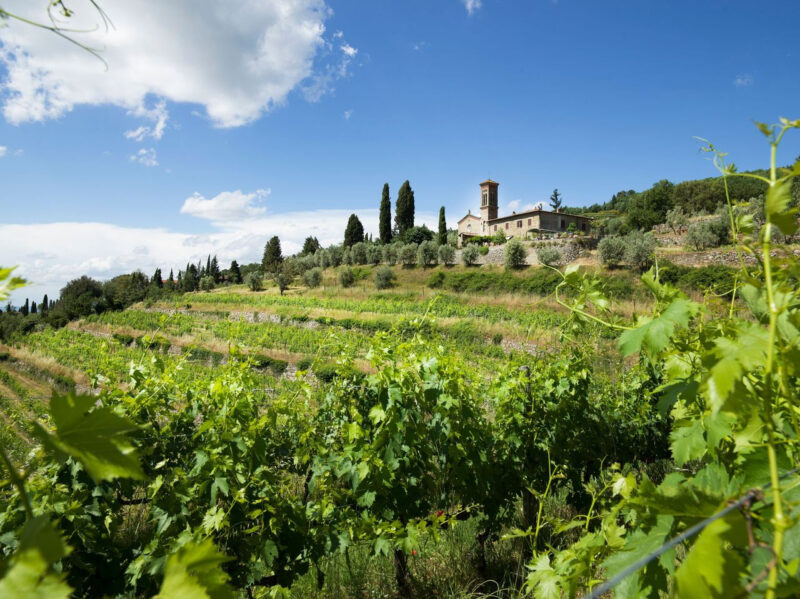
Keeping in step with the worldwide push to define the origins of food stuffs, Italian wine authorities have identified 11 subzones of Chianti Classico called UGAs, Unità Geografiche Aggiuntive (Additional Geographical Units). Think of them like village appellations, such as Gevrey-Chambertin or Beaune, in Burgundy or like subregions of Napa Valley, such as Oakville or Stags Leap District. As in Burgundy or Napa, the terroir of Chianti Classico varies enormously, so it comes as no surprise that the wines from one UGA will be different from those of another. Unraveling the differences among Chianti Classico’s UGAs is difficult because it’s hard to distinguish the producer’s hand – their winemaking style – from the influence of the particular UGA. If, for example, I taste Antinori’s Chianti Classico Badia a Passignano from the San Donato in Poggio UGA next to Cecchi’s Chianti Classico from Castellina, the neighboring UGA, how do I know the differences are due to the producers’ styles or the inherent differences unique to the UGAs? The answer is – I can’t, and you can’t either.
To really sense the difference between UGAs, you need to taste wines made by the same producer because that eliminates the winemaking style as a variable. This exercise is relatively easy in Burgundy due to the traditional way the wines have been – and still are – marketed by négociants. These firms purchase grapes and make wine from throughout the many Burgundy appellations, spanning hundreds of miles, using the same winemaking philosophy and techniques. Even a novice consumer can descend into the cellars of Maison Louis Latour, Maison Joseph Drouhin, or Maison Louis Jadot (to name just a few of the venerable Burgundy négociant houses) and easily perceive the differences between wines from Gevrey Chambertin and Volnay or between Chablis and Chassagne-Montrachet. Contrast that to Chianti Classico, where the tradition has been that small family-owned estates produce wine from the local village. A farmer owning land in Radda would not have the ability, nor the desire to, make wine from neighboring Gaiole. The Burgundy négociant system of one producer buying grapes from throughout the region and bottling scores of different wines has never been the norm in Chianti Classico. Everything in Chianti Classico was, and still is, done on a hyper-local level.
That tradition in Chianti Classico makes unraveling the UGAs difficult.
Querciabella is changing that.
Coincident with the arrival of winemaker Manfred Ing in 2010, well before the concept of UGAs was formulated, Querciabella initiated a project, “Genius Loci” (or, the spirit of place) to identify specific vineyards. The goal, as their website states elegantly, is all about, “translating the unique dialogue between the site and Sangiovese into wines of clarity, elegance, and precision.” Querciabella started in 2010 by bottling a Chianti Classico made exclusive from Sangiovese grown in a vineyard in their home base of Greve. By the following year, they had expanded the project to include Chianti Classico, also made exclusively from Sangiovese, from a vineyard in the UGA of Radda, then one from the Gaiole UGA, and most recently, from the Lamole UGA. Over the years, they have bottled, but not released, a couple of thousand bottles from each UGA that they have kept as a remarkable resource which allows them to see how the wines evolve with bottle age. It gives them unparallelled ability to assess plot development.
Starting with the 2021 vintage, regulations for Chianti Classico allow Gran Selezione wines, the apex of the Chianti Classico quality pyramid, to carry the UGA on the label. So, with the 2021 vintage, Querciabella has released three wines as Gran Selezione with the name of the village, Greve, Radda, or “Sa-La” – for Sangiovese from Lamole. (Italian bureaucracy delays using Lamole on the label until 2027.) Ing makes the wines entirely from Sangiovese and is not wedded to using the same vineyard every year. Instead, he selects the vineyard that he believes best represents the village that year. He wants to convey the character of the UGA, not that of a particular vineyard.
To be fair, other producers, like Fonterutoli with their Vicoregio 36 from Gaiole, Castello Fonterutoli from Castellina, and Badiola from Radda, as well as Fontodi with their Vigna del Sorbo from Panzano and their Pastrolo from Lamole, to name just two, also allow consumers to explore the differences among the UGAs, but, to my knowledge, Querciabella likely has the deepest experience with the idea.
Ing explains that the winemaking is basically the same for three 2021 Gran Selezione carrying the name of the UGA. Querciabella has gradually reduced the influence of oak aging over the years by moving away from smaller barrels. Over the years since Ing arrived, they’ve gone from using 1,200 to 300 small barrels. By 2016, they had more large barrels than small ones. Ing states emphatically, “Sangiovese speaks better in larger barrels.” The three 2021 Gran Selezione have been aged mostly in six-year-old, 2,000- to 3,000-liter oak casks.
Querciabella’s three 2021 Gran Selezione releases are simply stunning wines in and of themselves, and perhaps even more importantly, they illuminate the dramatic and unique character of the three UGAs.
Querciabella’s 2021 Gran Selezione Sa-La, from Lamole, reflects the racy style of Chianti Classico from Lamole’s high altitude and cooler UGA, where the vineyards sit between 500 and 650 meters above sea level. The cooler climate produces a lighter and fresher fruit profile, suggesting red raspberry than red cherry. It’s a more delicate, weighing in at a modest 13 percent stated alcohol, but none the less persuasive, expressive of Sangiovese compared to the more powerful one in Greve, only two kilometers away. The Sa-La’s elegance and length stop conversation (95 points, $200). Ing attributes the style, in part, to the exposure and sandstone soil. The vineyard receives little of the strong morning sun and far more of the weaker afternoon sun. Ing explains, “you have to have your wits about you to get the grapes ripe.” He notes that the harvest can occur in late October in some years.
Though Lamole abuts the southern point of Greve, the latter UGA imparts an entirely different character to Sangiovese. Here, morning sunlight and clay/schist (galestro) soil produce a heftier profile with deep, dark cherry-like nuances. Gorgeous aromas burst from the glass in this riper, 14 percent stated alcohol expression of Sangiovese. Still, like Querciabella’s Sa-La, fine but firm tannins and uplifting acidity provide support and balance (97 pts., $200).
Querciabella’s 2021 Gran Selezione from the Radda UGA is even more structured with darker fruit compared to the one from Greve because, with south facing vineyards sitting on a vein of galestro, it’s a warmer site. Despite its power, the wine maintains incredible poise and elegance, truly a proverbial iron fist in a velvet glove (96 pts., $200).
When I met with Ing in May, we also tasted the 2016 bottlings of the wines from Greve and Radda, which, at a decade of age and despite the development of mature nuances, still showed the clear delineation of the UGAs. (Querciabella started to make Sa-La only in 2021). Ing describes the differences among the wines as the “magic of the terroir.” Judging from the 2016s, the three 2021 Chianti Classico Gran Selezione from Querciabella will pay enormous dividends from a decade or so in the cellar, despite how delightful they are to taste and drink now.
Some might argue that the UGAs are irrelevant for the vast majority of U.S. consumers and, even worse, may be off-putting and confusing. And that’s probably true, since many casual consumers still fail to understand the difference between Chianti Classico and Chianti.
(For those who need a review: Both Chianti Classico and Chianti have distinct and sperate DOCGs [Denominazione Origine Controllata e Garantita], with separate regulations for each. Those for Chianti Classico are more stringent. Chianti, a vast area in central Tuscany encompassing vineyards that extend from near Pisa to around Florence to Siena and beyond, is comprised of seven subregions, not to be confused with the UGAs of Chianti Classico: Chianti Rùfina, Chianti Montalbano, Chianti Colli Fiorentini, Chianti Colli Senesi, Chianti Montespertoli, Chianti Colli Aretini, and Chianti Colline Pisane. The much smaller Chianti Classico area, while geographically the heart and most important part of the greater Chianti region, is not a vinous subzone of Chianti, but rather a distinct wine-growing area.)
Despite the potential for confusing today’s U.S. consumers, I applaud the Chianti Classico producers for identifying the UGAs and using them on labels. I, for one, hope they allow Riserva and Annata bottlings to carry the UGA as well.
As expected from a region with centuries of history behind it, the producers appear to be taking the long view, looking to the future. As the saying goes, “the best time to plant a tree was 20 years ago. The second-best time is today.” In twenty or fifty or a hundred years, the names of the UGAs will guide consumers to a particular style of Chianti Classico and be as familiar to people as Gevrey-Chambertin or Chambolle-Musigny are today.
. . .
E-mail me your thoughts about the UGAs of Chianti Classico in general or Querciabella in particular at Michael.Apstein1@gmail.com and follow me on Instagram @MichaelApstein
July 22, 2026