
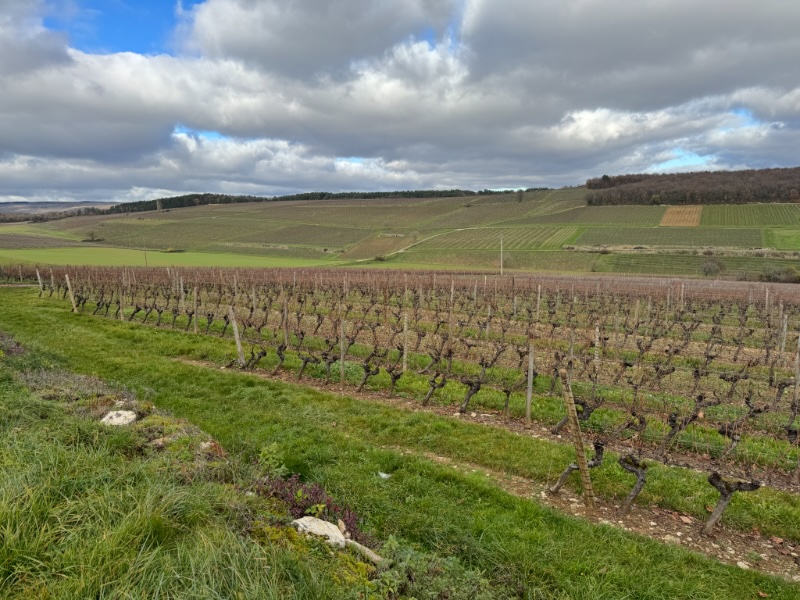
As I explained in Part 1 of this profile series, the Hautes Côtes is poised to take off as the next “in” Burgundy appellation because of climate change and affordable prices for vineyards: https://apsteinonwine.com/2026/01/02/the-hautes-cotes-the-next-hot-spot-for-affordable-burgundy-part-1/. Part 2 detailed some of the new producers who are taking advantage of the opportunities there: (https://apsteinonwine.com/2026/02/11/hautes-cotes-part-2-new-producers-in-the-next-hotspot-for-affordable-burgundy/. Here, in Part 3, we’ll look at producers who knew all along about the potential of Hautes Côtes.
The smiling Danièle Bonnardot, of the eponymous Domaine Bonnardot, is the current face of this family estate that spans three generations and covers about 52-acres, 45 of which lie in the Hautes Côtes de Nuits and the remainder in the Côte d’Or. The bright and stony 2024 Hautes Côtes de Nuits, named “Les Frangines,” contains a bit of Pinot Beurot (a.k.a. Pinot Gris) that Danièle believes adds roundness and balances the minerality of the Chardonnay (94 pts., n/a—meaning, not yet released, and price not yet possible to indicate precisely due to inflation and tariff variables). The name is slang for two sisters since the vines come from two plots, one facing east and one west, planted with two years of each other. In contrast, Bonnardot’s punchy 2023 Hautes Côtes de Nuits “Clos des Oiseaux,” still showing the traces of oak from a year’s worth of barrel aging, should come into balance in another year’s time (91 pts., n/a). Bonnardot’s snappy 2024 Bourgogne Aligoté, from her roughly 16-acres of that grape planted in the Hautes Côtes de Nuits, is just fabulous, infused with minerals from the limestone-rich soil and alive with riveting energy (94 pts., $23). Bonnardot’s talents also show in her reds. The charming mid-weight 2023 Hautes Côtes de Nuits l’Âge Mûre enhances its black fruitiness with subtle peppery notes (93 pts., n/a).
Nicolas Thevenot Brun represents the fifth generation of the family-owned Domaine Thevenot Le Brun. He is justifiably proud of their monopole, Clos du Vignon, which has always been held in high regard, since, according to him, documents show that it was planted in the 14th century. His grandfather purchased the vineyard in the 1930s after it had been abandoned. Currently planted to Chardonnay and Pinot Noir, much of the vineyard dates from the 1960s, which helps explain the wine’s stature. The racy 2021 Hautes Côtes de Nuits Blanc, “Clos du Vignon” impresses with its distinctive and cutting minerality (93 pts., $29), while the 2023 delivers greater ripeness and richness, reflecting the warmth of the vintage (92 pts., $23). The midweight red 2023 Clos du Vignon, perfect for current drinking, showed the “flavor without weight” magic of Burgundy accented by a touch of spice (93 pts., $24 for the ’22).
Although the reds from the recent vintages from Hautes Côtes are a delight to drink now, Nicolas, echoing what Saito demonstrated with Petit Roy’s Ronsin (detailed in Part 2) showed that their reds developed beautifully with bottle age. The tannins of the youthful 2023 Hautes Côtes de Nuits “Les Renards” reinforced the power of the wine, overshadowing its elegance at this stage (90 pts., $31), while the lively 2016 from a cooler vintage, had fine tannins and startling elegance (93 pts., n/a). The outstanding 2015 Renards, from a superb vintage, showed the true potential of the wines from the Hautes Côtes de Nuits, briming with refinement and substance. (95 pts., n/a).
With their purchase of Château de Charmont there in 1954, Maison Edouard Delaunay, a prominent and well-respected Burgundy négociant, remains firmly embedded in the Hautes Côtes de Nuits. Delaunay clearly believes in the potential of the appellation since they have recently completed an upgraded state-of-art gravity flow winery there. Maison Edouard Delaunay, became a prominent négociant in late 19th century, thrived for most of the 20th century, but fell on hard times and was sold in 1993. Enter Laurent Delaunay, fifth generation of the family and a successful wine merchant who established the Les Jamelles brand in the Languedoc. Coming full circle, he managed to buy and return Maison Edouard Delaunay to family ownership in 2017. Their racy white 2021 Bourgogne Hautes-Côtes de Nuits “Charmont,” a blend of Chardonnay (90%) with Pinot Blanc, has sufficient depth to balance its bright profile (91 pts., $43). The rounder 2022 Charmont will please those who prefer a touch more body in their wine (91 pts., $43). Their minerally 2021 white Bourgogne Hautes-Côtes de Nuits “Le Mont,” from a lieu-dit closer to the limestone ridge of the Côte d’Or, delivers a balanced and cutting precision and, not surprisingly, shows the importance of site (93 pts., n/a). Delaunay vinified and aged their substantial 2022 white Hautes-Côtes de Nuits, “Les Lares,” in used oak barrels, which adds a touch of complexity that complements its minerality without intruding (92 pts., n/a).
Delaunay does equally well with their reds from the Hautes-Côtes de Nuits. The light to mid-weight and charming red 2022 Bourgogne Hautes-Côtes de Nuits “Charmont” delivers a splendid combination of fruitiness balanced by herbal elements. The fine tannins indicate that the coarseness of wines from this appellation can be a thing of the past. A wine to drink with a roast chicken! (93 pts., $43). The bright 2023 highlights cherry-like fruitiness to accompany those fine tannins. (92 pts, $43). The more substantial 2022 Bourgogne Hautes-Côtes de Nuits “Les Dames Huguettes” has Charmont’s same fine tannins and lovely texture. Fresh and long, a touch of oak is still apparent at this stage, which I anticipate will integrate nicely within the next six to 12 months (93 pts., n/a). Gabriel Camphuis clarifies that the small quantities of Le Mont, Les Lares, and Les Dames Huguettes limit their distribution, which explains why they are not available in the U.S.
Founded in 1922, based in Échevronne in the Hautes Côtes de Beaune, and producing wine since 1969, Domaine Jean Féry is another of the old guard in the Hautes Côtes. Their 80-acres of vineyards are spread over the Hautes Côtes, the Côte d’Or, and Givry. They do not receive the recognition they deserve, which is a good thing for consumers because it means their pricing is more reasonable, so, although I am focusing on their Hautes Cotes de Beaune, be on the lookout for their other offerings. They embraced organic viticulture early with all their vineyards achieving organic certification in 2011. François Lecaillon, formerly from Domaine de la Vougerie, became winemaker here in 2023, while Laurent Féry is in charge.
Lecaillon refers to Féry’s floral 2023 white Hautes Côtes de Beaune as “relaxed,” a drink-it-now, more casual style of wine. Though the focus here leans towards fruit more than minerals, a tinge of white pepper in the finish provides balance and adds to its appeal. (91 pts., $42).
Féry’s seductive 2022 Hautes Côtes de Beaune, “La Combe des Amoureuses,” made entirely from Chardonnay, shows the heights the wines from this appellation can achieve. It’s an elegant harmony of fruitiness and minerals with a long and explosive finish. Give it another year or so if you can keep your corkscrew away from it. (95 pts., $45). The riper and more floral 2023 “La Combe des Amoureuses,” reflecting the character of the vintage, is a delight to drink now (92 pts., $45).
A vineyard that lies between Pernand-Vergelesses and Échevronne provides the Pinot Noir for Féry’s red Hautes Côtes de Beaune. The more structured yet elegant 2022 delivers bright and fresh cranberry-like fruitiness (93 pts., $45), while the harmonious and lush 2023 has excellent supporting structure, especially for the riper vintage (93 pts., $45). The suave texture of both erases any memory of the rusticity of these red wines of the past.
Three producers who fit both the “new” and the “old” categories deserve special attention thanks to the quality of their wines.
Domaine Nicole Lamarche (formerly Domaine François Lamarche) dates from the 18th century, but their enticing Hautes Côtes de Nuits rouge, which hails from a vineyard just above their home in Vosne-Romanée, is a product of the 21st century. Their stylish 2022 has the poise and understated elegance emblematic of the Domaine with a touch of spice that is reminiscent of Vosne-Romanée itself (93 pts., $59). The similarly pretty and mid-weight 2023 display more raspberry-like fruitiness and fewer savory notes yet has the same elegance and gracefulness (91 pts., $47).
Étienne Camuzet acquired vineyards in Vosne-Romanée in the early 20th century and leased them to the famed Henri Jayer, who farmed them for decades and in the process acted as mentor to the family. The estate passed to Étienne’s daughter and then to her nephew, Jean Méo, who gradually ended the leases and formed the Domaine Méo-Camuzet, keeping the name of the founder as a way of honoring him. Jean’s son, Jean-Nicolas Méo, the current director, was responsible for transforming the estate into the super star estate that it is now, one the best in all of Burgundy. It was he who decided to plant Chardonnay and make the Domaine’s sole white wine in a forlorn vineyard, Clos Saint-Philibert, in the Hautes Côtes de Nuits decades ago. From my experience, having tasted many vintages over the years, this minerally-infused white displays a lovely stoniness that distinguishes it from the creamier style of whites from the Côte de Beaune. The mid-weight and lively 2022 Clos Saint-Philibert is particularly good with beautiful acidity that amplifies its considerable charms (93 pts., $79).
A top Gevrey-Chambertin-based grower, Geantet-Pansiot, has finally been seduced by the allure of the Haute Côtes. Vincent Geantet, the son of Edmond, who founded the firm in 1954, was dismissive of the Hautes Côtes, feeling it was suitable only for Crémant or perhaps everyday house wine. Fabien, his son, who is now in charge, thought that with climate change, things had changed, so in 2014 he purchased 25-acres in the Hautes Côtes de Nuits and within the last few years acquired another 5-acres in the Hautes Côtes de Beaune. Erwann Boivin, a representative of Geantet-Pansiot, emphasizes that the Hautes Côtes is the new frontier against climate change. He echoed Boris Champy’s assessment (expressed in Part 1), noting that “It is possible to find land for sale and then buy it. In Gevrey-Chambertin it’s almost impossible to find vineyards for sale and when you do, you can’t afford them.” Geantet-Pansiot’s charm-filled, mid-weight red 2023 Hautes Côtes de Nuits combines bright red fruitiness with herbal briary qualities that make it perfect for tonight with chicken thighs bathed in a mushroom sauce (92 pts., $36).
So, if you’re looking for authentic Burgundy at reasonable—for Burgundy, at least—prices, take my advice and ask your local wine merchant about Hautes Côtes wines from these producers or explore others that your local retailer recommends.
. . .
E-mail me your thoughts about Burgundy in general or the Hautes Côtes in specific at Michael.Apstein1@gmail.com and follow me on Instagram @MichaelApstein
March 25, 2026